


If you have to choose between Laser Scan and LiDAR Scan, it may not be an easy decision right away, as both technologies have different technological foundations.
Laser Scan
Laser scanning uses laser light to capture the geometric shape of objects by emitting laser beams onto surfaces and measuring the time it takes for the light to return. The distance is then calculated and used to generate a digital model, commonly known as a point cloud.
LiDAR Scan
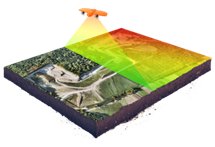
LiDAR (Light Detection and Ranging) is a remote sensing technique that scans an area by sending out laser pulses to measure distances and create a 3D map of the terrain. It captures reflected light and measures the time taken for the pulses to return, generating a point cloud representation of the scanned environment.
Comparison of Technologies
Use of Laser: Both technologies utilize laser light, but with different applications. Laser Scanning focuses on capturing fine details with high accuracy, whereas LiDAR is designed for large-area scanning and has better penetration capabilities.
Resulting Data: Both methods produce point clouds, but Laser Scan provides higher density and detail, making it ideal for structural modeling and inspection. Meanwhile, LiDAR data is similar to Synthetic Aperture Radar (SAR), offering lower resolution but covering larger areas more efficiently.
Laser Scan is best for high-precision and detailed modeling, such as structural analysis, inspection, and 3D visualization (VR applications).
LiDAR Scan is ideal for large-scale data collection and is widely used in vehicle-mounted systems, UAV-based terrain mapping, urban planning, and disaster monitoring.
Our company offers high-quality, industry-leading products and services. If you're interested in either of these technologies, feel free to contact us!
